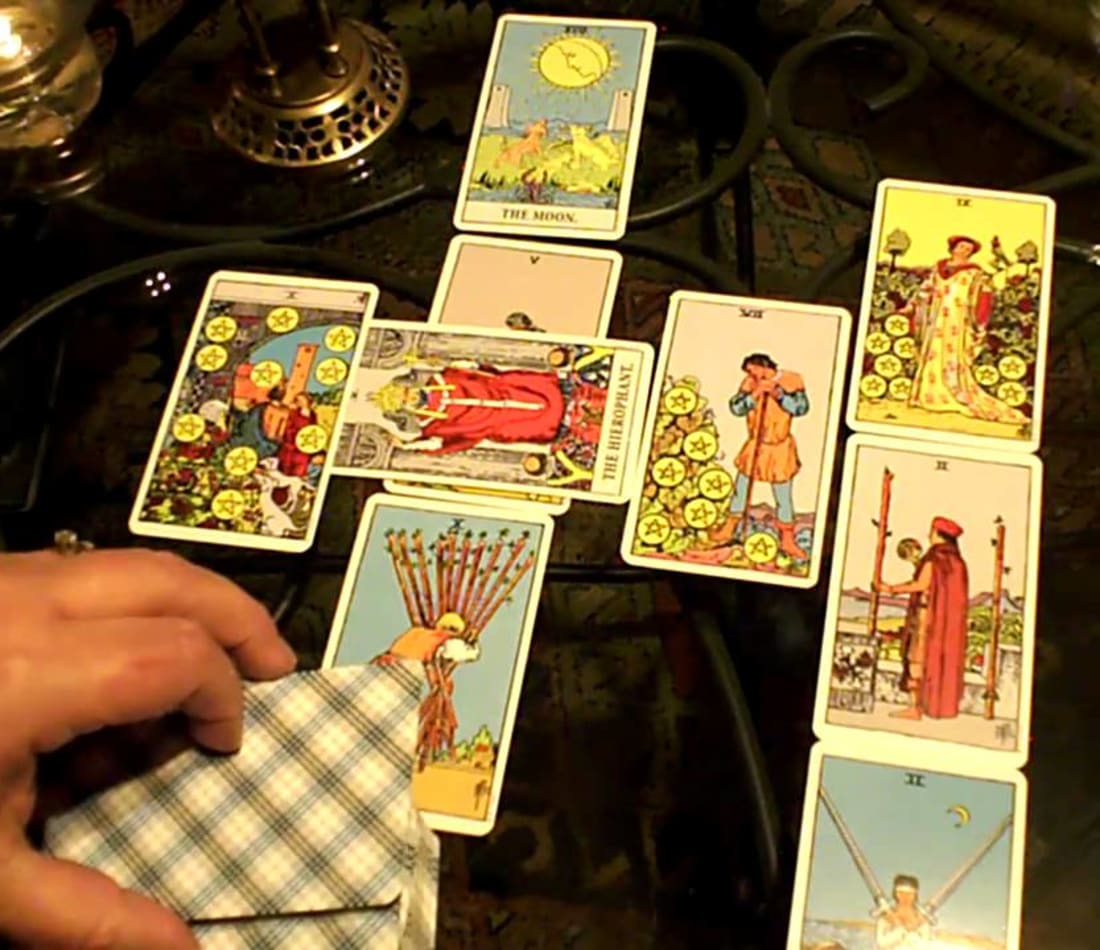
Tarot Reading is a traditional form of symbolic card interpretation in which selected cards are arranged in a particular pattern, or spread, and interpreted in relation to a person's question or situation.
For someone discovering tarot for the first time, the number of cards, symbols, suits and different spreads can seem overwhelming. However, the basic idea is easier to understand when it is divided into three parts: the cards, the spread and the interpretation.
What Is Tarot Reading?
Tarot Reading traditionally involves a deck of illustrated cards that are selected and arranged to explore a question, theme or situation. The images and symbolic elements on the cards provide a framework for interpretation.
A tarot reading may focus on relationships, personal reflection, career questions, decisions, emotional themes, goals or other areas of life. The meaning assigned to a card depends not only on the card itself, but also on its position in a spread, its relationship with surrounding cards and the question being considered.
In this sense, Tarot Reading is not simply about memorising individual card meanings. It is an interpretive process that brings together symbols, context, intuition, traditional associations and the structure of the chosen spread.
Understanding Tarot Cards
A traditional tarot deck contains two broad sections: the Major Arcana and the Minor Arcana. Different tarot traditions and decks may vary in artwork, symbolism and interpretation, but this broad structure is commonly used as a starting point for learning.
Major Arcana
Major Arcana cards are traditionally associated with significant themes, archetypal experiences, transitions and larger patterns of personal development.
Minor Arcana
Minor Arcana cards are commonly used to explore more specific experiences, everyday situations, interactions, emotions, actions and practical circumstances.
Major Arcana: Larger Themes and Life Lessons
The Major Arcana consists of 22 cards traditionally numbered from 0 to 21. The cards are commonly interpreted through symbolic themes such as beginnings, choices, transformation, strength, responsibility, uncertainty and completion.
When a Major Arcana card appears in a reading, some readers interpret it as highlighting a theme that deserves particular attention. The precise interpretation still depends on the question, spread position and surrounding cards.
Minor Arcana: Everyday Experiences
The Minor Arcana is traditionally divided into four suits. Depending on the deck and tradition, the suits may be associated with different areas of human experience.
| Suit | Traditional Themes | Interpretive Focus |
|---|---|---|
| Wands | Energy, action, ambition | Motivation, creativity and initiative |
| Cups | Emotion, relationships, feelings | Emotional experiences and connections |
| Swords | Thought, communication, decisions | Mental processes, conflict and choices |
| Pentacles | Material life, resources, work | Practical matters, stability and resources |
These associations should be understood as traditional interpretive frameworks rather than fixed rules. A reader may consider the artwork, surrounding cards and the specific question before arriving at an interpretation.
What Are Court Cards?
Many traditional tarot decks contain four court cards in each suit: Page, Knight, Queen and King. Court cards may be interpreted as people, personality qualities, behavioural patterns, stages of development or approaches to a particular situation.
Their meaning is therefore contextual. A Queen does not necessarily have to represent a particular person, just as a Knight does not automatically represent a specific event. The reader considers the entire spread before interpreting the card.
What Is a Tarot Spread?
A tarot spread is the arrangement used to place selected cards. Each position in a spread has a purpose. For example, one position may represent the past, another the present and another a possible direction or consideration.
The spread gives structure to the reading. Instead of looking at each card independently, the reader considers how the cards interact with the questions represented by their positions.
One-Card Spread
A simple format often used for reflection around one focused question, theme or daily consideration.
Three-Card Spread
A flexible arrangement that may explore combinations such as past, present and future or situation, challenge and guidance.
Relationship Spread
A multi-position format designed to explore themes involving two people, communication, dynamics and relationship considerations.
Career Spread
A spread may be designed around professional direction, current circumstances, opportunities and considerations.
Decision Spread
A structured arrangement can be used to explore different aspects of a choice and the factors surrounding it.
Expanded Spread
Larger spreads contain more positions and may provide a broader symbolic picture of a question or situation.
How Tarot Card Interpretation Works
One of the most important concepts for beginners is that a tarot card does not necessarily have one universal meaning. Interpretation is influenced by context.
A reader may consider several elements simultaneously:
- The traditional symbolism associated with the card.
- The position occupied by the card in the spread.
- The question or subject being explored.
- The relationship between neighbouring cards.
- Whether the card is upright or reversed, when reversals are used.
- The imagery and visual symbolism of the particular deck.
- The reader's interpretive approach and experience.
Avoid treating a single tarot card as an isolated prediction. A reading is generally interpreted as a combination of symbols, positions and context rather than as a single predetermined answer.
Upright and Reversed Tarot Cards
Some tarot readers interpret cards differently depending on whether they appear upright or reversed. A reversed card is simply a card appearing upside down in relation to the reader.
Depending on the reader's tradition, a reversal may be associated with an internalised quality, delay, imbalance, resistance, alternative expression or another variation of the card's traditional symbolism.
Not every tarot practitioner uses reversed cards. Therefore, the absence of reversals does not mean that a reading is incomplete.
Why the Question Matters in Tarot Reading
A clear question can make a tarot reading easier to interpret. Broad questions may produce broad symbolic material, while a focused question can help define the purpose of the spread.
Examples of Clearer Questions
- What should I consider about my current career situation?
- What relationship pattern should I reflect on at this time?
- What factors should I consider before making this decision?
- What perspective may help me understand this situation better?
Questions framed around reflection and understanding can leave more room for interpretation than questions that assume a fixed outcome.
What Happens During a Tarot Reading?
The exact process varies between practitioners, but a consultation commonly follows a structure similar to the following:
Understanding the Question
The consultation begins by understanding the topic, circumstances and question the person wants to explore.
Selecting a Spread
A suitable spread may be selected according to the complexity and nature of the question.
Drawing the Cards
Cards are selected and placed in the positions defined by the chosen spread.
Interpreting the Pattern
The reader considers individual cards, their positions, symbolism and relationships with other cards.
Discussion and Reflection
The interpretation is discussed in relation to the person's circumstances, allowing questions and reflection during the consultation.
Tarot Reading and Astrology: Are They the Same?
Tarot and astrology are different traditional systems. Astrology generally works with birth information, planetary positions, signs, houses and related astrological frameworks, whereas tarot uses a deck of symbolic cards and their arrangement within a spread.
Some practitioners work with both approaches and may use them separately or as complementary forms of traditional guidance. However, the interpretive framework of each system remains different.
If you are interested in horoscope-based guidance, you can explore the Astrology Consultation service separately.
Tarot Reading for Beginners: Where Should You Start?
Beginners do not need to memorise every card immediately. A better starting point is to understand the structure of the deck and gradually become familiar with recurring symbolic themes.
Learn the Deck Structure
Understand Major Arcana, Minor Arcana, suits and court cards before attempting complex spreads.
Start Small
Begin with one-card or three-card layouts instead of immediately using a large spread.
Study the Imagery
Pay attention to colours, figures, objects, expressions and other visual elements within the deck.
Keep a Journal
Recording cards, questions and interpretations can help you understand patterns in your learning process.
Common Beginner Mistakes in Tarot
- Assuming every card has only one fixed meaning.
- Treating a single card as a complete answer.
- Choosing complicated spreads before understanding basic ones.
- Ignoring the question being explored.
- Treating symbolic interpretation as absolute certainty.
- Becoming overly dependent on repeated readings for the same question.
Tarot can be approached as a symbolic and reflective practice. Maintaining perspective is particularly important when a reading concerns major personal, financial, legal, medical or other consequential decisions.
What Should You Expect From a Tarot Reading?
The experience of a tarot consultation can differ considerably depending on the practitioner, deck, spread and question. A reading may provide a framework for reflection, explore symbolic themes or encourage someone to consider a situation from another perspective.
It is more useful to approach tarot with an open but thoughtful mindset rather than expecting every card to provide an absolute, predetermined outcome.
A responsible tarot consultation should encourage awareness, reflection and informed personal choice rather than replacing a person's own judgment.
Tarot Reading at Astro Jagannath
Tarot Reading is one of the traditional disciplines included within the professional profile of Prasannajit Mohanty, professionally known as Astro Jagannath.
The current Astro Jagannath professional profile describes Tarot Reading alongside Vedic Astrology, Nadi Astrology, Prashna Jyotish, Vastu Shastra and spiritual guidance. The profile also states that Prasannajit Mohanty pursued training in Tarot Card Reading through the All India Institute of Occult Science.
A tarot consultation can therefore be considered as a separate interpretive service from a traditional horoscope consultation. If your question requires birth-chart analysis, you may instead explore Vedic Astrology Consultation .
Frequently Asked Questions About Tarot Reading
What is Tarot Reading?
Tarot Reading is a traditional interpretive practice using symbolic cards arranged in spreads to explore questions, themes and situations.
How many cards are in a tarot deck?
A traditional tarot deck commonly contains 78 cards: 22 Major Arcana cards and 56 Minor Arcana cards. Specific decks may vary in design or structure.
What is a tarot spread?
A tarot spread is an arrangement of cards in which each position represents a particular aspect of the question or situation being explored.
What is the difference between Major and Minor Arcana?
Major Arcana cards are traditionally associated with broader symbolic themes and archetypal experiences, while Minor Arcana cards generally explore more specific and everyday areas of experience.
Are reversed tarot cards necessary?
No. Some readers use reversed cards while others interpret all cards upright. The choice depends on the reader's method and tradition.
Can Tarot Reading answer every question?
Tarot is an interpretive practice and should not be treated as a guaranteed source of factual or predetermined outcomes. Important personal, medical, legal or financial decisions should be considered using appropriate professional information as well.
Can Tarot Reading be done online?
Online tarot consultations can be conducted through digital communication depending on the practitioner's consultation format.
Is Tarot Reading the same as astrology?
No. Tarot and astrology use different traditional interpretive systems. Tarot uses cards and spreads, while astrology works with astrological charts and planetary symbolism.

About the Author — Prasannajit Mohanty
Prasannajit Mohanty, professionally known as Astro Jagannath, is an astrologer, Vastu consultant and life coach based in Raipur, Chhattisgarh. His professional profile includes Vedic Astrology, Nadi Astrology, Prashna Jyotish, Tarot Reading, Vastu Shastra and spiritual guidance.
Looking for a Personal Tarot Consultation?
Explore a personalised Tarot Reading with Astro Jagannath and discuss the question or life situation you would like to reflect upon through a traditional tarot-based approach.
Explore Tarot Reading →